





-
Free delivery from £70 for the United Kingdom | Same-day shipping on orders placed before 1pm*
-
Black November: 5% off from £100, 10% off from £200 and 15% off from £300 on the entire store until 9 november (Excluding discounted products, Therm-A-Rest, MSR, Stoots, Big Agnes, Santa Madre & Nemo)
Power banks: lightweight and reliable for hiking and travel
On a hike, your phone doubles as a GPS, camera, backup torch and way to call for help. A power bank keeps it working throughout your trek. At Freezedried & Co, we select power banks built for the outdoors: lightweight, compact and durable, with capacities from 5,000 to 20,000 mAh. Use them to charge your smartphone, head torch, GPS watch or camera.
Why take a power bank hiking?
Digital maps, photos, messages and activity tracking can drain a smartphone quickly in the mountains. Searching for a signal and cold weather use up its charge even faster. A power bank lets you spend several days away from a socket while keeping energy in reserve for the unexpected. It can also charge rechargeable head torches, GPS watches, earbuds and small cameras.
How do you choose a power bank for your phone?
Capacity: how many mAh do you need?
Capacity is measured in milliamp-hours (mAh). As a guide, a 10,000 mAh power bank can charge a typical smartphone about twice, while a 20,000 mAh model can charge it about four times, depending on the phone’s battery capacity. Some energy is lost during charging, so the actual number of charges is always lower than the theoretical figure.
- 5,000 mAh: for a day trip or a night bivvying, with minimal weight.
- 10,000 mAh: the best balance for a weekend or a hike lasting a few days.
- 20,000 mAh: for multi-day treks without access to power, or charging several devices.
Weight
Weight increases with capacity. The lightest 10,000 mAh models weigh around 150 g (5.3 oz), while 20,000 mAh models weigh roughly twice as much. Carbon-cased power banks or models with high-density cells can save a few precious grams. Choose the capacity you actually need: an oversized power bank adds unnecessary weight.
Ports and fast charging
Check that the ports match your cables: USB-C, which is increasingly common, and USB-A. A power bank with fast charging (Power Delivery or Quick Charge) charges your phone faster and recharges itself more quickly — a real advantage during a short stop at a mountain hut or café. Multiple ports let you charge two devices at once.
Durability in outdoor conditions
On a hike, your power bank may face rain, dust and knocks. Some models have a water and dust protection rating, shown on the product page. Either way, keep it and your cables in a waterproof bag.
Power banks and solar panels: staying charged on multi-day trips
For long treks, pair your power bank with a portable solar panel attached to your rucksack. The panel charges the power bank as you walk, and the power bank stores energy to charge your phone in the evening. A panel’s output depends heavily on sunlight and how it is positioned, so treat it as a supplement and always set off with a fully charged power bank. Explore our full power and energy range.
Getting the most from your power bank on a hike
- Protect it from the cold: lithium batteries lose capacity in freezing temperatures. At night, tuck your power bank and phone into your sleeping bag.
- Save your phone’s battery: switch to aeroplane mode when you don’t need a signal, download maps in advance and turn down the screen brightness.
- Charge it before you leave: a power bank slowly loses charge even when it isn’t being used. Fully charge it the day before you set off.
- Store it partly charged: between seasons, a partial charge and a moderate storage temperature help preserve its lifespan.
- Don’t forget your head torch: a USB-rechargeable head torch saves you carrying spare batteries.
Taking a power bank on a plane
Power banks must travel in cabin baggage, never in the hold. Airline rules are based on capacity in watt-hours (Wh), which is shown on the power bank. Standard models up to 20,000 mAh are generally below the 100 Wh limit allowed without special approval. Always check your airline’s rules before you travel.
Our power bank brands
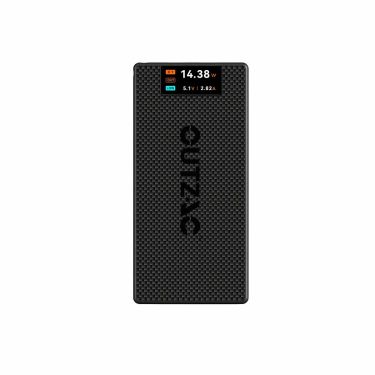
Choose Nitecore for its ultralight, durable power banks, popular with long-distance hikers. Outzac and X-Moove offer versatile models, while Sunslice makes power banks and solar panels designed for multi-day trips. To lighten the rest of your pack, explore our top ultralight gear and our full range of bivvy gear.
Power bank FAQs
What power bank capacity do you need for a phone?
A 10,000 mAh power bank is enough for most needs: it can charge a typical smartphone about twice. Choose 5,000 mAh for a short trip, or 20,000 mAh for several days without access to power or for multiple devices.
How many times can a 10,000 mAh power bank charge a phone?
About twice for a typical smartphone. It depends on the phone’s battery capacity and energy lost during charging, so the actual number of charges is lower than the theoretical figure.
Can you take a power bank on a plane?
Yes, but only in cabin baggage. Standard models are generally below the permitted 100 Wh limit, but check your airline’s rules.
Does a power bank work in cold weather?
Yes, but its capacity drops noticeably in very cold weather. Keep it warm in an inside pocket during the day and in your sleeping bag at night.
Do you need a solar panel as well as a power bank?
For a trip lasting a few days, a power bank with the right capacity is enough. For several weeks on the move without access to electricity, a portable solar panel lets you recharge it as you walk.
We’re here to help
Not sure which capacity or weight to choose, or whether a power bank will work with your devices? Contact us or visit our shop in Lorient. We’ll help you find the right power bank for your adventures.